Full article The Brook Bullhead by Dr Simon Wright
Articles by Dr. Simon Wright.
123 Not Out
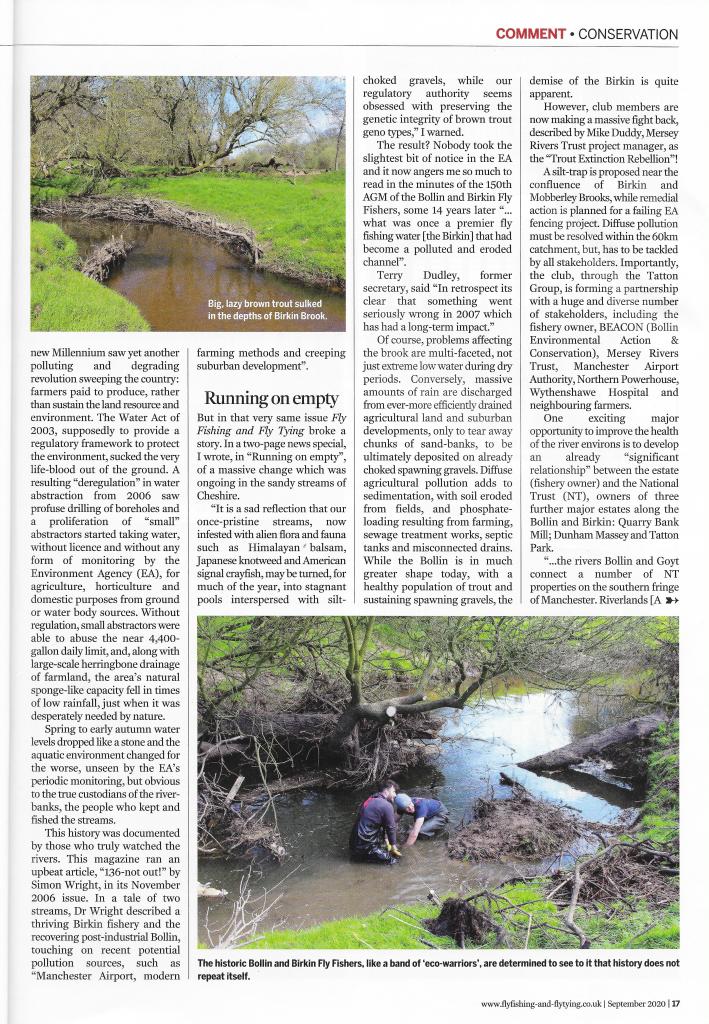
Nestling within the Cheshire Countryside and carving its path through the old Tatton & Egerton Estates, on the outer edge of South Manchester, is the meandering Birkin Brook, a tributary of the River Bollin. This attractive stream is home to the members of the Birkin Fly Fishers Association which this year celebrates its 135th anniversary (Footnote at the end of the article) and a history that has been full of enjoyment and some spectacular fishing.
The association was established on 23rd February 1870 as the Bollin Angling Association by four local gentlemen whose first official meeting recorded in the Minutes their future purpose: “The Preservation of Trout in the River Bollin”. For a few years the Association, with a permitted maximum of forty members, was preoccupied with formulating rules and increasing its scope of fishing. From Castle Mill to Bollington Mill catches of trout were heavy, particularly on the natural May fly. Some six years later pollution began to affect the quality of the fishing and the fly life. Subsequent minutes of the club meetings recorded “a great and rapid deterioration in the fishing”. Although the Association may not have been aware of its cause at that time, the most likely component of the rivers decline was Manchester’s expanding industrialisation. Despite this now known obvious cause, the decline in 1876 was ascribed to the activities of its then keeper, an unfortunate Mr. Collins, who was unjustly discharged on this account.
There then followed subsequent years records of the association that included press accounts of public and Council meetings, actions in the Courts and correspondence with various authorities, all concerned with ending the industrial and other pollution affecting the river; but it was to no avail. This realisation was too late for the ex-river keeper and too late for the fishery. The very damaging effects of pollution persisted on the River Bollin and in one form or another continued until very recently. More modern-day developments such as Manchester Airport, modern farming methods and creeping suburban development took over from old style industrial pollution in creating a decline of the River Bollin. However, contemporary wisdom, and more rational actions, has seen a huge improvement in the water quality that may eventually see it restored to a thriving fishery of its pre-industrialised period.
The decline of the River Bollin as a substantial and sustainable fishery caused members to abandon their interest and by 1900 there had been very many resignations on account of destruction of the fishing. The Association in an attempt to maintain its existence obtained from Lord Egerton, at a nominal rent, the lease of the Birkin Brook fishing below the Stone Bridge at Ashley, and in 1917 a further lease of the Birkin up to Tatton Park. In 1933 the Mobberley Brook up to Chapel House Inn was added. This provided a very sustainable fishery and for some seventy-two years the members have fished the Birkin in quiet contentment, and substantially trouble‑free.
The Birkin Brook fishery firmly established the Association continued to maintain both its interest and fishing rights to many parts of the River Bollin and some hardy members to this day occasionally traverse overgrown banks and substantial vegetation to track down trout in its waters. The history of the Bollin fishery developed into that of the Bollin & Birkin Fly Fishers and for over sixty years, until 1943, with some short breaks, the Association operated a hatchery on the Bollin. These fish populated the waters of the Bollin and its tributary, Birkin Brook, where undoubtedly some of their ancestors still reside. In the early days, prior to the creation of that hatchery, trout fry was sent from Scotland in a railway van and carried from Manchester in barrels on a horse‑drawn dray, such was the determination of the association to create and maintain the fishery.
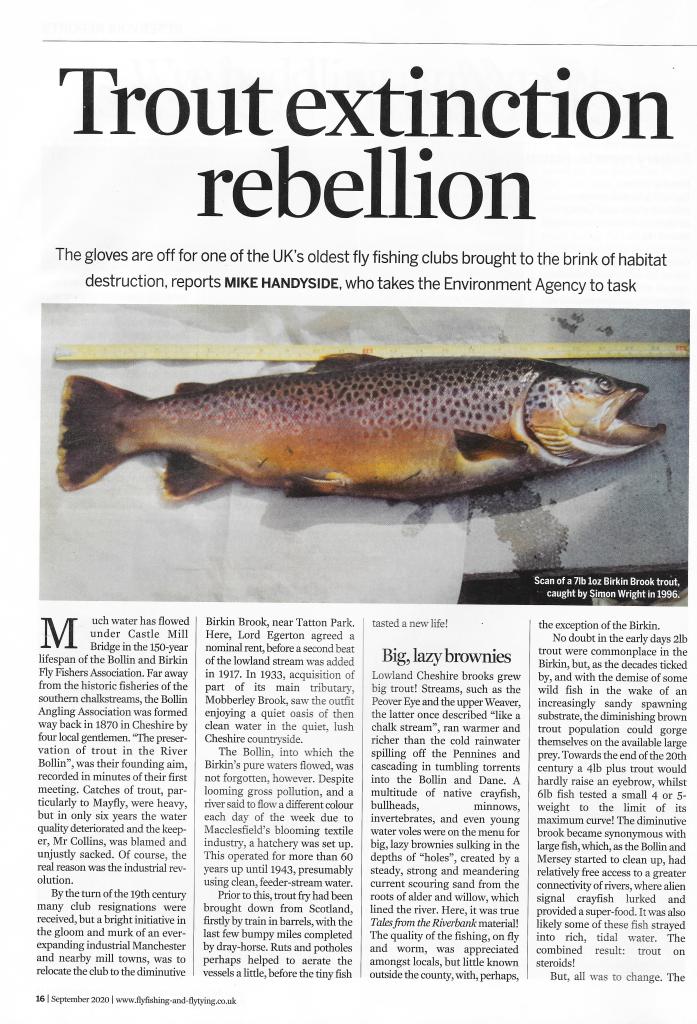
In 1943 the hatchery ceased, and little occurred on the Bollin until In 1968 part of the Bollin water again became capable of supporting fish and the Association extended its leases into new areas of the river. Today, the River Bollin continues to improve and there is even talk of migratory trout returning to the river. Sightings of leaping salmon have occurred further downstream below Lymm, and scientific studies have occurred to race migratory trout. To date, no such sea running migratory fish have been either seen or caught on Birkin Brook, but the fishery here does support a good head of brown trout and a variety of course fish with gudgeon, stone loach and bull heads in substantial numbers and size. In 1996 I was fortunate to capture the existing record trout of 7 pound & 1 ounce on this amazing water, and regularly fish in figures close to that are caught. This season has already produced more than 11 leviathans in excess of 4 pound and current season’s best of around 6 and a quarter pound. Scale analysis has suggested that fish of this size have migrated from the stream to still freshwater and then later returned to the stream within 12 – 18 months. Such rapid growth rate for the fish suggested a migratory habit, but analysis has shown that these fish do not run to sea and must therefore put on their substantial growth in still freshwater. I believe this is a phenomenon akin to the Sonahan of Ireland, where fish migrate from running water to still, pack on weight and then return to their native origins to breed. In addition to the unique environment of the Birkin stream, which is packed with natural food items, this particular migratory phenomenon might provide an indicator of how such wonderful fish are maintained in such a small river. Fish of this pedigree are indeed trophy fish, yet members rarely take fish and more than 75% of fish are returned each year. Rather like the members that fish it, to live in quiet contentment, and substantially trouble‑free.
The Association has a dedicated band of enthusiasts who work on the improvement of the fishery, and the club’s existing mantra is ‘Birkin Fly Fishers, working with nature’. This level of dedication has seen the condition of the banks; water access and abundance of fly life improve incrementally year on year. Despite a predominantly sandy bed, intermittent gravel and weed beds have allowed flies such as Yellow Sally, Blue Wing Olive, and Mayfly to increase and this position has been further improved with the general husbandry and introduction of a fly board system. Other natural fishy foodstuffs include free swimming caddis, shrimp, and nymphs such as heptageniid, are all in abundance. Birkin fish our very well fed and well cared for. What we try to do is ensure that nothing intervenes to spoil the environment.
The fishing on the Birkin can be best described as quality ‘rough stream’, and not for the feint hearted or those with dubious physical capacity. Many aspects of the banks are steep and uneven with the sandy components of its structure eroded by the weather, currents and in parts, the local cow population. These attributes provide challenging fishing and seeks to maintain members ‘of the third age’ in the peak of physical [fishing] fitness.
When the fish are moody, or they are determined to be difficult, the walk along the Birkin banks alone is a treat, where the site of hares, kingfishers and buzzards are common amongst other more expected wildlife. The meandering stream stretched out provides approximately five miles of double bank fishing in five beats for all different levels of ability. A highly successful method for the wilier resident browns is upstream nymphing and those who practice this method are frequently rewarded. A deftly placed dry fly also brings results, and for those with the confidence to try it, often when no fish are rising and the fly cast in a speculative fashion. Because many aspects of the natural food source is either sub-surface or river bed dwelling, that is most often where you may find a fish. In order to maintain a natural habitat with shade and shelter for the fish [and retain the odd challenge] bushes and trees have been allowed to remain over favoured pools, some of which possess long and fabled histories. This policy led to the evolution of the most commonly practiced method of fishing that became known as the ‘Birkin Drift’. Akin to angling alchemy, this skilfully well practiced method will produce trout of memorable proportions to the delight of the members. The method, for those who haven’t yet guessed involves the paying out of line under the overhangs of a sheltered trouty haunt, with a heavy, yet highly realistically tied food imitation on the end. This is then retrieved with the variety and skill of the person at the other end, done properly – and wallop – pure joy! Of course, a little bit of luck is also involved, but the more it is practised the luckier you become.
Last year the Birkin Fly Fishers Association celebrated its 135th year of existence. The life of the club spans centuries and the span of its member’s generations. With so much talent, experience, friendliness, and spirit of common purpose, on this treasure of the north of England, we will hope to continue to work with nature and enjoy this special stream for many future decades.
Note in 2020 the club celebrated its 150th anniversary.
| Birkin Bull Heads, Baffle Brown’s Dr. Simon Wright explains an alchemy of the stream . . . . . . I have the privilege and pleasure of fishing a Cheshire stream that is packed with sizeable trout, and equally, sizeable challenges in how to catch them. That stream is Birkin Brook situated on the Tatton Estate and it nestles within the Cheshire Countryside as it carves its way through the outer edges of South Manchester and Cheshire for about 5 miles before it joins the River Bollin. This very attractive stream on the old Tatton and Egerton Estates is home to the Birkin Fly Fishers Association which this year celebrates its 140th anniversary and puts it amongst the oldest of fly-fishing clubs. Sightings of leaping salmon have occurred further downstream on the Bollin, and scientific studies have occurred to trace migratory trout. To date, no sea running migratory fish have been either seen or caught on Birkin Brook, but the fishery does support a good head of Brown Trout and a variety of coarse fish with Gudgeon, Stone Loach and Bull Heads in substantial numbers and size. There are also stocked Rainbow and Blue Trout each season to keep sagging spirits alive when the browns can be difficult, but the very special aspect of Birkin Brook is its migratory Browns. These special fish actually migrate from the Birkin to still water through connecting streams and pack on weight by eating all manner of fish and crustaceans found in the meres and lakes that they visit. These fish can reach some phenomenal sizes and Brown Trout in excess of 5 pound are regularly caught each season, but perhaps unusually being very young in age, and when they return to Birkin Brook, they predominantly continue their cannibalistic habit. Fish of around 6 – 7 pound are also caught and indeed the record Brown Trout is currently 7 Ib 1 oz on this amazing water. Greater leviathans lurk beneath the pretty surroundings in the depths but tempting them can occasionally be both a test of will and endurance. The stream is packed full of natural food and shrimp, caddis and other fly life are abundant alongside the myriad of small fish, this is effectively a trout’s heaven. Despite a predominantly sandy bed, intermittent gravel and weed beds have allowed such as Yellow Sally, Blue Wing Olive, and Mayfly to increase and this position has been further improved by the general husbandry of the fishery and a fly board system. The fishing on Birkin Brook can best be described as “rough stream” fishing and walking along its banks can be a real delight where the sight of Hares, Kingfishers and Buzzard are common. A highly successful [though generally little practiced] method for the wilier resident Browns is upstream nymphing, and those who do practice this method are frequently rewarded with good fish. A deftly placed dry fly can also bring results, and often this is a “speculative” dry fly even when a rise isn’t that evident. However, because many aspects of the natural food is sub surface, or river bed dwelling, that is most often where you will find the fish. In order to maintain as natural habitat as possible with shade and shelter for the fish [and retain the challenge for the angler] bushes and trees have been allowed to remain over many favoured pools, some of which possess long and fabled histories. This policy led to the evolution of the most commonly practised method of fishing that became known as the “Birkin Drift”. This is akin to angling alchemy on this fishery; this skilfully well practiced method will produce trout of memorable proportions. The Birkin Drift method involves the paying out of line under the overhangs of a sheltered trouty haunt, with a heavy, yet realistically tied food imitation on the end. Then it is retrieved with the variety and skill of the fisher. Done properly – wallop – pure joy! Of course, there is a little bit of luck involved, but the more that you practice, the luckier you become. In the last decade Birkin Brook tended to “buck the trend” in the decline of fly life, as Mayfly and other up-winged flies seemed to increase in their number where other fisheries have seen a decline in their fly life. This had the effect of producing some fine rises, usually at dusk but still the main feeding has occurred either just under the surface, or towards the bottom of the stream. In fact, because the upstream nymph method is not widely used, and the rises to surface fly occurring at dusk, most of our fish are caught below the surface and this applies equally to Brown and Rainbow Trout. Last month the Editor referred to this phenomenon elsewhere, and fish in many streams are now predominantly caught, sub surface. Elsewhere this may be because of a decline in surface fly, but this is not the case at Birkin Brook, but the masses of sub surface food have generated a predominantly sub surface feeding habit by the trout who will seek out the easiest meal. In 2005 Birkin Fly Fishers commissioned a scientific survey of the stream and a component of that was the electro fishing of the stream. The volume and quality of the small fish captured during the exercise was staggering. Gudgeon, of probably record proportions were caught, so too fine Bull Heads and Stone Loach in numbers that could not be ignored as significant, and plentiful, food items for our trout. This drove me to the reference books, and my fly-tying bench, to design a fly for the Birkin and attempt to emulate the fishy larder that the trout enjoy. I looked for fish fry patterns and eventually came upon Dave Whitlock’s Sculpin, a pattern designed for stream fishing in the USA and one with a proven record of success. I fiddled and tweaked the pattern as fly dressers do and came up with two that I use, and have used, to very good effect to imitate the Bull Head and the Stone Loach. Both the Bull Head and Stone Loach are bottom dwellers and that is where the trout find them. The Bull Head particularly scurries and jerks amongst the sand and detritus of the riverbed and I wanted a pattern that could do just that, and in the process, kick up a little silt as it did so, just like the real thing. To that end, I wanted a pattern that would drive its head and shoulders into the sand and silt without getting caught. In addition to the Sculpin pattern, I “kicked about” various Muddler patterns, as the Muddler seemed to emulate the shape of the Bull Head especially, but less so the Stone Loach. The pattern then began to emerge as a hybrid of both the Sculpin and the Muddler, but it still lacked the ability to drive itself into the silt as the Bull Head does, so I researched a little more. I wanted a pattern that would “kick up the dust” on the riverbed and give itself away to the cautious, if hungry large trout, just like the living model. In my research I remembered an older fisher who I knew as a young man. He used ‘keel flies’ to good effect for sea trout, and I tracked down some suitable hooks and began to experiment with keel hooks. These hooks allow for the weight to be placed at the shoulder and head and became just perfect for my purposes, and the Keel Hook Sculpin Muddler evolved. The success of this pattern was really good and many large, and indeed ordinary sized, trout have succumbed to it. I have settled on two patterns, one for Bull Head [predominantly Muddler style], and one for Stone Loach [Gudgeon], [[Predominantly Sculpin Style]], so I have actually taken the styles from elsewhere and just changed the proportions and colours to suit my purposes. The key to making this work is the weighting at the shoulder and head, as it drives the imitation into the sand. There are occasional drawbacks as you can get caught under a log and lose a pattern, which after taking up to an hour to make it is a pain, but all of that annoyance and anguish is abated when you catch a 5 pound fish, or above, on one of these keel flies. Fishing them can be tricky, for if you try to cast these patterns in a conventional manner you will surely come to grief. Patience and stealth is the way to make these work. I swing the bait into the desired spot and let it sink towards the riverbed. If need be, then “pay out” some line in a Birkin Drift style until it arrives at the spot you want it to be. Then, leave it there. Sit down and rest a while. That is the hard bit because the temptation to rush to action is great, but ruinous. Stay alert, but not active. That is, be prepared for a trout snatching your bait, but do not move it yet. Let the bait sink into the silt like a natural and let the current of the stream perhaps gently push it to one side or the other. After a while lift the rod and “tweak” the bait in a small darting action. It is often on this first deliberate movement that a fish will attack from deep holes, undercuts in the bank or a weed bed, but if not, repeat the process through the pool. In-between each episode let the bait settle again on the riverbed. You are thereby imitating the natural quite well. Takes are unambiguous, bearing in mind that a large trout will feed infrequently thereby restricting the need for unnecessary movement, and when it does so, it will do with the purpose of securing its prey. In deep water you will not see your bait, and the same can be said for coloured water, but the fish will see it and I have had rods literally double over in an instant when a fish has struck. The contrast is immense, steady sedate fishing, whist thinking about the gentle movement of the bait, employing stealth and purpose to “bang” intense mayhem as you begin to battle with a large fish. It is both an exciting and exhilarating form of fishing. The line rig that I use for all of this is a floating No5 with a Roman Moser sinking leader and approximately 5ft of tippet. That keeps the bulk of the line where I can see it, but still helps the lure anchor where I want it. You can extend the length of the tippet, but the longer the leader the trickier it can be to place the lure exactly where you want it. The Pattern: The Bull Head [Muddler] Hook: Mustard Saltwater Keel Hook [Stainless Steel] – Size 4. (Pattern no 79666s). Thread: Any strong dark coloured thread, suitable for spinning deer hair. Weight: Lead wire wound from halfway down the body up to [and including] the shoulder of the hook [illustrated]. For a heavier water version, I sometimes double the coverage. Tail: Black / Brown Chick-a-boo feather for the first part of the tail. This is tied in a horizontal plane to the hook and allows it to fold and expand in the current and looks very life like. Body: Rabbit – Winter Coat, spun heavily, tightly, and reasonably thickly. Top / Bottom of entire body – Brown Rabbit Zonkers, ribbed with silver oval tinsel. Tie these Zonkers to the same length as the tails of the Chick-a boo to form the full tail. These will be in the vertical plane to the hook. When wet, this will move with the current, up and down. 1st Collar: Light Tan Sculpin Wool. 2nd Collar: Chestnut Brown Deer Hair spun and left trailing over the body, but partly clipped at the front Eyes: [optional] Lead dumbbell eyes, or similar. Head: Spun Black deer hair clipped. The Stone Loach: Hook: Mustard Salt Water Keel Hook [Stainless Steel] – Size 6. (Pattern no 79666s). Thread: Any strong dark coloured thread, suitable for spinning deer hair. Weight: Lead wire wound from half way down the body up to [and including] the shoulder of the hook [illustrated] Tail: Rabbit Zonker. Body: Rabbit – Winter Coat, mixed with green “lite brite” and tightly spun Top of entire body – Brown Rabbit Zonkers, ribbed with silver oval tinsel. Gill Cover: Grouse wing hackle at either side . Collar: Light Brown Deer Hair spun and left trailing under the body, but partly clipped at the front Eyes: [optional] Lead dumbbell eyes, or similar. Head: Sculpin hair in Light Tan, spun and then clipped. Nb; I have also included a lighter dressed and lighter coloured version utilising two gold beads at the collar. This is altogether a lighter variation of the pattern. The Stone Loach is a much slender fish, so the pattern tries to reflect that. These are “ugly” looking patterns, but the entire effect is achieved when the patterns are wet. The body, the sculpin wool etc all soaks up water helping to make it sink, but they also seem to fill out to make a highly realistic silhouette. The lightness of the tail and the trailing deer hair sways and pulses in the current and the overall desired effect is of life within the pattern. You just have to inject that jerky, darting motion once it is in position on the bottom of the stream. Experiment, practice – enjoy. |
Food to go …….
Small streams, hungry trout and opportunities …. Simon Wright describes a little ‘fast food’ for thought?
Continuing with various food analogies, first mentioned in my article “Junk Food”, I moved from considering how best to make an artificial from items ordinarily cast aside in our everyday lives, that is, flies made from ‘junk’ to those specific items of food that trout are unlikely to ignore. The food items to which I will refer are those common to the fish and, for them, provide both opportunity and availability to the hungry predator, effectively ‘fast food’. In rivers and streams these are most often items such as Caddis, shrimps, and nymphs.
I came to refer to these items as ‘fast food’ not because the creatures themselves are fast, although some are, but because the time scale between the trout encountering the creature and the decision, followed by action, to eat it can be particularly short. Often very fast indeed. How often have you been surprised by a trout coming to your fly as soon as it hits or enters the water? It happens, and often with such a surprise element that we fail to connect with the fish.
My particular view on what makes a good artificial fly is one that comprises of five essential criteria: Profile, size, shape, colour, movement. Get this right and all you must do is find the fish and deliver this ‘must have’ item in a most natural manner – simple. It is a question of placing the angler in a position of greater advantage than the fish.
The most uncertain aspect is finding the fish and then the proper delivery of the fly, but I am often perplexed by the disadvantage anglers place themselves under by using flies that clearly ignore any rules about profile, size, shape & colour. Fortunately, this disadvantage is relatively easy to rectify by the thinking angler.
Follow a few simple rules.
(1) Drag out some old branch or similar piece of detritus from the stream and see what is attached to it or turn over a few stones – make an effort to establish what the water you wish to fish holds in terms of the natural food.
(2) Select an artificial that in some way represents some of those naturals, (&/or perhaps trigger points).
(3) Select a size that is slightly bigger than the real thing. This will mean that yours stands out from the other million naturals that might be in there
(4) Use materials that will emulate the colour and shades of the natural when it is wet. Some flies look fine away from the water but when wet they take on a totally different persona. Consider what they will do when they are wet, and what effect the type of water will have on them. If water is sandy, greenish coloured or crystal clear this will affect how your artificial looks. A startlingly bright fly on a clear stream can send a wary fish to the cover at ‘breakneck’ speed, yet a dull, mucky looking fly in colouring water may never be seen. Overall, put a fly in the water that has a profile of a natural item, is bigger than the fish might expect, and be one that can be seen as about the right colour. Do these things and the odds swing greatly in the favour of the angler. Common sense perhaps, but so often these points are ignored, or worse, are not even considered.
Studies on a small stream afforded me the opportunity to analyse some of the ‘fast food’ phenomenon. We know that trout are predatory, often lazy, yet will turn in an instant to something upon which they are feeding or may wish to feed. We also know the frustration of either placing an artificial onto the nose of a trout, or in drifting our offering past its mouth only to have it ignored. Such confusions? We also often relate to trout becoming fixated on specific food items, or just being off the feed and clearly all of this can happen. Weather and water conditions can also play their part, so to, our ability not to be seen and therefore viewed as a threat to the fish. The components of whether a fish will ‘take’ or not are myriad. Then there are things sometimes referred to as feeding zones – the times of a day [dependent on the time of year], or the location at those times at which a fish is more likely to feed. Moon cycles, weather, barometric pressure. They are all important components to be considered when fishing for trout. However, many of these known and valid concerns or considerations can neglect the most obvious reason why a fish will feed on a ‘fast food’ item – opportunity and availability. It can be taken purely because it is there, and it looks edible – in short, the fly is taken when opportunity meets availability. It is for us as anglers to make them meet at every encounter.
In the Cheshire stream that I fish on a regular basis, Birkin Brook, there is a common mix of structure and sub-structure. Here the banks are sandy, the bed is predominantly both silty and sandy, but it is punctuated with some good runs of gravel and weed beds. The geography of the stream provides some very deep pools, long deep runs but also shallow riffles. The banks are tree lined and this provides a regular source of logs and other detritus in the stream. Tree roots together with some reed beds hold the banks together. In all, this terrain provides many varied environments for valuable food sources of fish, and the stream is literally stuffed with food.
Caddis both cased and free swimming
Shrimps
Nymphs of Olives and Blue Winged Olives
Damsel Nymphs
Mayfly Nymphs
Dragon Fly Larvae
Yellow May Dun
Stone flies
Small fish fry
Leeches
Eels – elver
So many varied food items without even counting those things that fall into the river or stray upon it not being water borne. But then, once the artificial has been determined how best then to make the opportunity meet the availability?
Presentation: Once again this is something that can be overlooked because many aspects of it can be so obvious. If it can be determined that a particular food item could be taken by trout because it impersonates something it may wish to eat, presenting it in the way that the fish would expect may seem obvious. However, it is all too easy to get to this stage, having selected the right imitation for the job and present it in a manner wholly inappropriate for the task. You wouldn’t serve a Crème Brule for ‘starters’, would you? So, a little thought about how the food item is to be presented to the trout is equally as logical as the fly selection itself. So, I would recommend any angler to ponder on this to improve their chances.
Cased caddis crawl the bottom of the stream, free – swimming caddis become dislodged and are carried down the stream tumbling and swimming as they go. Shrimps effectively dart about in a seemingly erratic fashion. So just with these items different aspects of fishing are applied, depth, speed, pattern of movement. Get these about right and you can be into a fish.
I have found the best way to achieve presentation is to consider the type of leader used, the weight of the fly and the position it enters the water, then how it is to be retrieved – if indeed it is. Heavy weights, light weights, upstream nymphing, they are all components of successful presentation. But consider this. You can make an artificial heavy enough to sink, but render it lifeless, equally, you can present a light mobile artificial that doesn’t perform in the way it should, and you can waste your time, certainly not the fishes, because it probably won’t bother with it. Often there is both a question of balance, and one of compromise to be applied. For example, I would fish an olive nymph, lightly dressed, but perhaps on a slow sinking leader cast upstream. This converts to a nicely presented item drifting in the steam across the eye-line of a fish in a way that it recognises. The fish probably has 3 – 5 seconds to decide what to do….
It all reminds me of that advert …. This isn’t just food …. This is correctly presented “fast food”.
Think – fish – enjoy!
Blue Winged Olive Nymph:
Hook: Size 14 or 16.
Thread: Brown Olive
Tails: A few fibres of Brown Partridge.
Body: Teased out wool from a hank predominantly dark brown but with the odd fleck of green or dark blue. Teased into a fluffy dubbing and then spun onto the thread. Rib: Optional. I use either a very fine black thread or if it needs zinging up a little fine gold wire, wound into the body to create a slightly segmented effect.
Thorax: As body.
Legs: Brown Partridge splayed to either side of the nymph.
Thorax cover: A few strands of Pheasant Tail.
Cased Caddis:
Hook: Size 10 or 12 Long shank.
Thread: Brown Olive
Head: Tied in at the bend of the hook and onto the rear of the shank a tungsten or black bead. Thread a small length of chenille through the bead and tie down onto the hook. The colour for the chenille can vary, but I use, white, green, orange or pink.
Body: Dub rabbit body fur into a dubbing loop, spin and wind onto the hook. I find the best fur is that long hair that you get from a rabbit with a winter coat.
Optional Legs / Hackle at the bead end: Brown Partridge, two turns.
Shrimp:
Hook: Size 10 or 12 [Grub Hook or Straight to suit you].
Thread: Olive green or orange, I tie my shrimps in these two colours
Under body: Square lead for virtually the length of the hook, but try and maintain a slim profile.
Rib: 4lb Nylon coloured with a permanent marker
Body/ Legs: A narrow strip less than the gape of the hook wide, of organza ribbon with the outer edge of the ribbon [the bit that is bound] forming the tying edge.
Shell back: Thin skin or similar or the desired colour. I often just use a thin strip cut from a plastic bag of the correct colour.
The sequence:
Wind the square lead along the hook, and then tie in the thread
Take the thread from the eye of the hook to the bend tying in the rib material, and Colour the rib with the permanent marker.
At the bend tie in the narrow strip of organza ribbon
Tie in the shell back
Wind the tread back to the eye in open turns
Wind the organza back to the eye and tie in
Bring over the shell back and tie in
Follow with the rib in open turns, tie in, and whip finish.
Organza ribbon can be bought at a haberdashery. Get the ribbon with a fine outer edge. This can be either white [later coloured with a permanent marker] or of the desired colour if you can get it. Cut a strip about 2 – 3 mm wide and 10 cm long. Get a needle and tease out the long fibres to leave only the short fibres fastened to the out edge – cut a tag at one end of about 2mm and tie in as described above.These legs really kick in the water and look very life like.
 Bollin and Birkin Flyfishers